Viewing your audit logs
Your audit logs provide detailed insights into event activity in your team. You can view this information within your Celonis Platform , as an exported .CSV file, and by using an API call.
Audit logs are useful for the following reasons:
Security and accountability: Use logs as a "black box" to monitor User role changes, track IP addresses when enabled, and identify unauthorized access or system setting modifications.
Compliance and data governance: Meet legal requirements by automatically deleting audit logs according to company retention policies and ensuring data is handled per internal standards.
Automated troubleshooting and debugging: Investigate business-critical processes by requesting Action Flow execution logs and reviewing the history of automation successes and failures.
Operational transparency and reporting: Maintain a "source of truth" for team activity by exporting logs as CSV for audits and identifying when users might need additional training.
To view your audit logs:
Click Admin & Settings - Audit Logs.
Click the Define Period field to select the specified time period for which you want to view logs.

View the audit log information. When viewing your audit logs, the following information is available:
User ID
Event - For an overview of all events and their meanings, see: Audit logs - Event details.
User role
Date
Message
IP address (when enabled)
Note
For a more detailed look at Action Flow audit logs, see: Audit logs - Action Flows
To download your audit logs and your Action Flow logs:
Click Admin & Settings - Audit Logs.
Click the Define Period field to select the specified time period for which you want to view logs.
Note
This time period must align to the first 500 results in the interface.
Click Download and select either Download Action Flow Execution Logs (.csv) or Export as CSV.
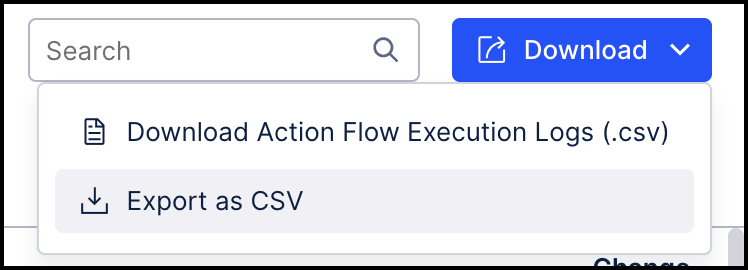
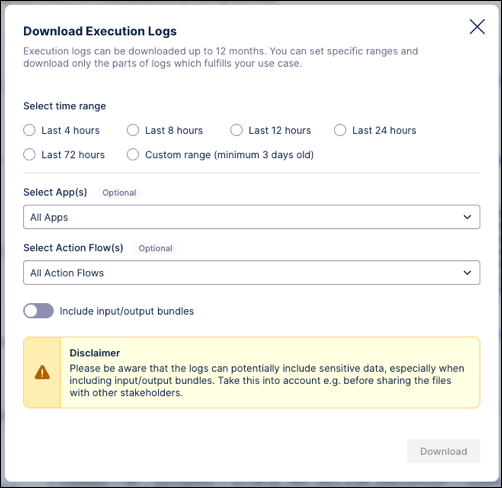
Choose from the following:
Action Flow Execution Logs: Select the time range, applications, and Action Flows to download.
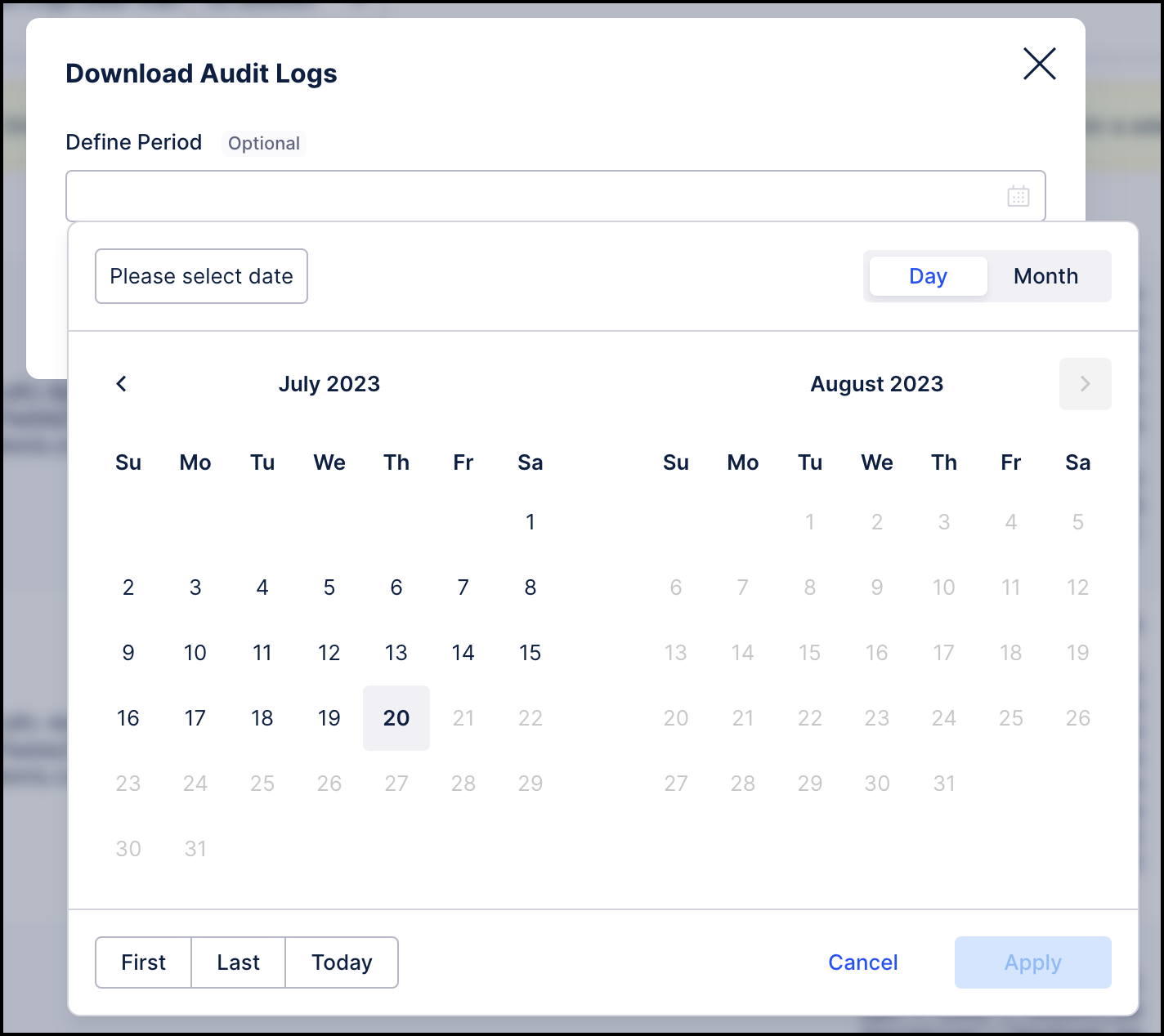
Export as CSV: On the Download Audit Logs screen, use the date selection window to select the timeframe for your download and click Apply.
Click Download.
The download starts, giving you offline access to your audit logs.
You can periodically delete your audit logs, with no recovery available once this data has been deleted. This content is deleted by midnight of the day your configured timeframe expires.
To automatically delete your audit logs:
Click Admin & Settings - Audit Logs.
Using the Delete Audit Logs drop, select from the following: No deletion, 30 days, 90 days, 180 days, 1 year, 2 years, 10 years.
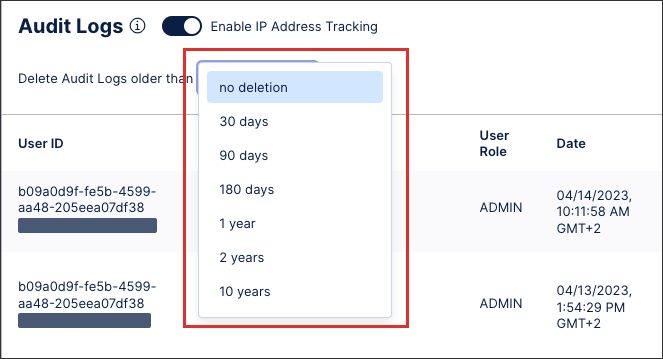
If older audit logs exist, confirm that you're happy to delete them by typing DELETE when prompted.
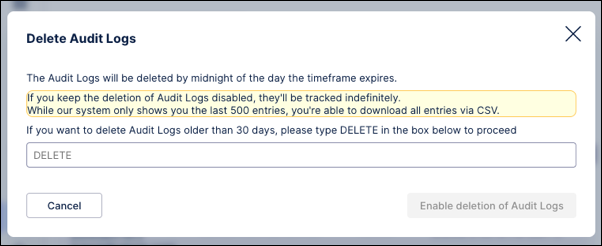
Click Enable deletion of audit logs.
Your audit logs are now deleted by midnight of the day your configured timeframe expires.